Sport courts
Half Court vs Full Court: Sizes and What Fits Your Yard
A full high school court is 84 by 50 feet, so a half court is 42 by 50. What actually fits a backyard: the lines, the room around them, the hoop and lights.
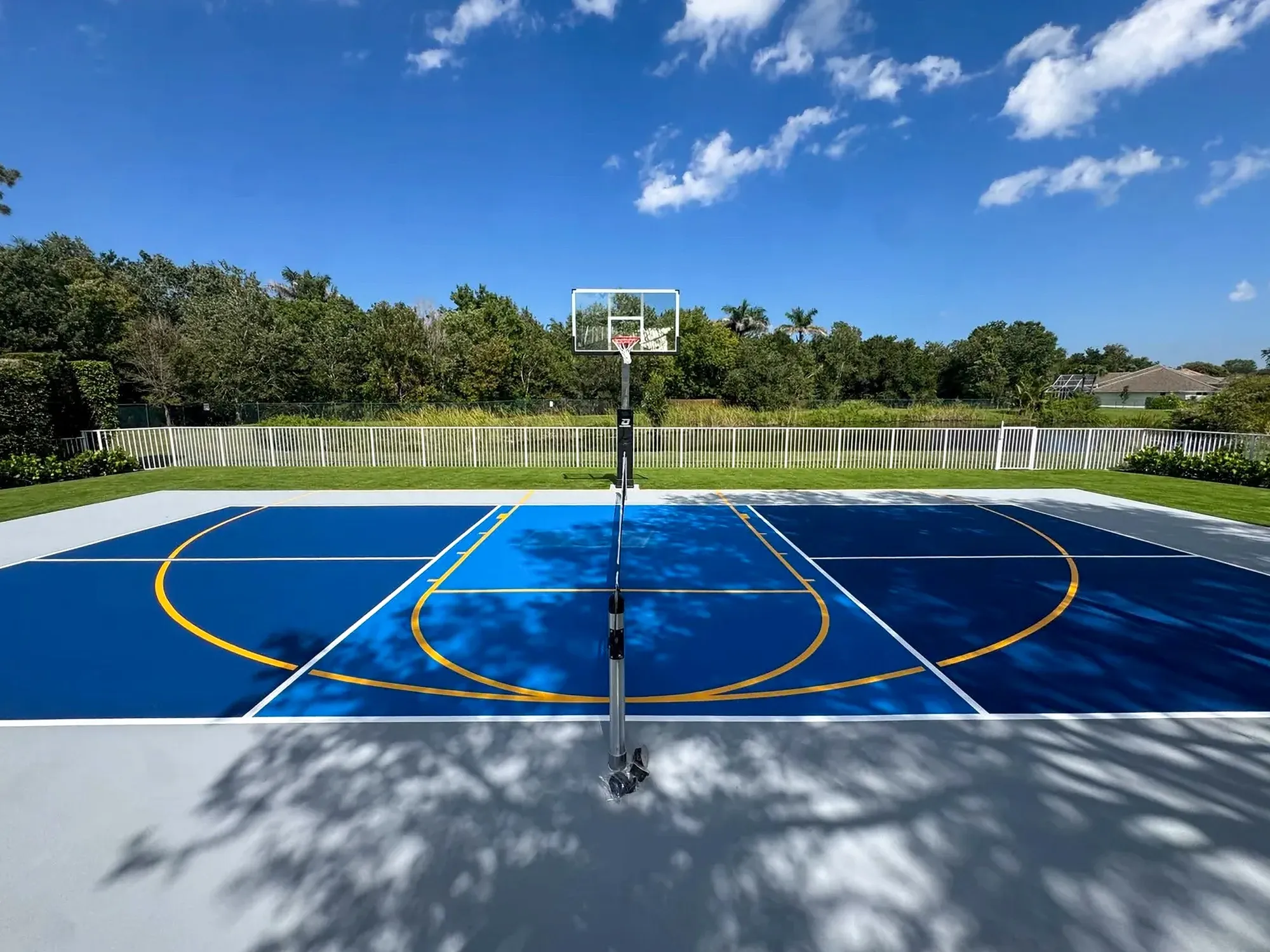
Most people start by asking for a half court or a full court. A full high school court is 84 by 50 feet, so a half court is 42 by 50. The better first question is what your yard can actually hold, because a court needs more room than its lines.
The lines
Basketball. A high school court is 84 by 50 feet under the NFHS rules, so a true half court is 42 by 50. Few backyards have that, and they do not need to. What makes a court feel real is a smaller set of measurements:
- a rim at 10 feet
- a free-throw line 15 feet from the backboard
- a lane 12 feet wide
Pickleball. A pickleball court is 20 by 44 feet, the same for singles and doubles.
The room around the lines
This is the number people forget. Players run past the lines, so a court needs space around it. USA Pickleball’s minimum playing surface is 30 by 60 feet, and it recommends 34 by 64 for new courts. That is the footprint to measure for, not 20 by 44.
Basketball is the same idea. You want room behind the baseline and past the sidelines, so nobody finishes a layup in a hedge or against a pool fence.
Where the hoop goes
An in-ground hoop’s pole stands behind the court, and the backboard reaches out over it. That reach is called the overhang, and it changes the layout. On Dominator’s goals it is 2.5 feet on the 54″ glass hoop, 3 feet on the 60″ and 4 feet on the 72″ models.
More overhang keeps the pole further from the play under the basket. It also means the pole needs that much more yard behind the baseline.
If you want to see it before anything is dug, you can put the 72″ hoop in your own yard at true size with your phone.
Where the lights go
If you will play after dinner, lights change the plan too. One of Dominator’s 16 ft poles with a single 150 W head lights about 30 by 30 feet, which is one end of a small court. That is why our court packages are built around how many poles they use:
- The Essentials: one triple-head pole.
- The Elite: two double-head poles.
- The Pickleballer: four single poles spaced around the court, for even light with no shadows or hot spots.
- The Full Court: four triple poles, lighting it end to end.
Each pole needs its own footing, in its own spot outside the playing area.
Setbacks and rules
Before any of this, your city or county, and your HOA if you have one, decide how close a court, a hoop and a light pole can sit to your property line. Some also limit how late lights can run. Those rules vary by neighborhood, so check them early. Then, on the free on-site visit, we measure the yard and tell you honestly what fits and what does not.
So, half or full?
If the yard is short of a half court, one surface can do both. Our Essentials package pairs a 72″ adjustable hoop with a portable pickleball net for exactly that. If you have the room and a household that plays properly, The Full Court puts a hoop at each end.
The equipment packages start at $5,487 in brushed aluminum, and the court surface is quoted once we have seen the yard. Ask us for a quote, or price your yard first.